
Important information in your area
Across the UK, water wholesalers regularly monitor local water resources to ensure supply remains resilient for businesses and communities. From periods of dry weather to increased seasonal demand, wholesalers may introduce measures to protect supplies and encourage customers to use water efficiently.
We’re supporting these efforts by keeping you informed and sharing guidance to help your business manage water responsibly and reduce unnecessary use.
See below for any current notices from The Environmental Agency and wholesalers in your area.









Affinity Water
October 2026
Water resources/Hosepipe Ban Update
This year has brought persistent hot, dry weather. England recorded its warmest June, with temperatures reaching as high as 38°C, and driest July on record, with just 6.5mm of rainfall, around 10% of the average.
On 10 August, the Environment Agency formally declared drought across more than two thirds of England, including our Central and East regions. After a long dry period, ground nearer the surface needs time to become wet enough for rainfall to soak down and 'fill up' the groundwater. The Environment Agency estimates that England needs around 120% of its typical rainfall over the next seven months for all areas to recover from drought.
As a reminder, we introduced a hosepipe ban across our Central region and most recently extended this to our East region on the 17th August (see map below) which will continue until further notice.
Further information on the Temporary Use Ban, including detailed restrictions and exemptions, can be found here:
Temporary Use Ban - Help & Guidance | Affinity Water
Temporary Use Ban - Frequently Asked Questions | Affinity Water
Groundwater levels
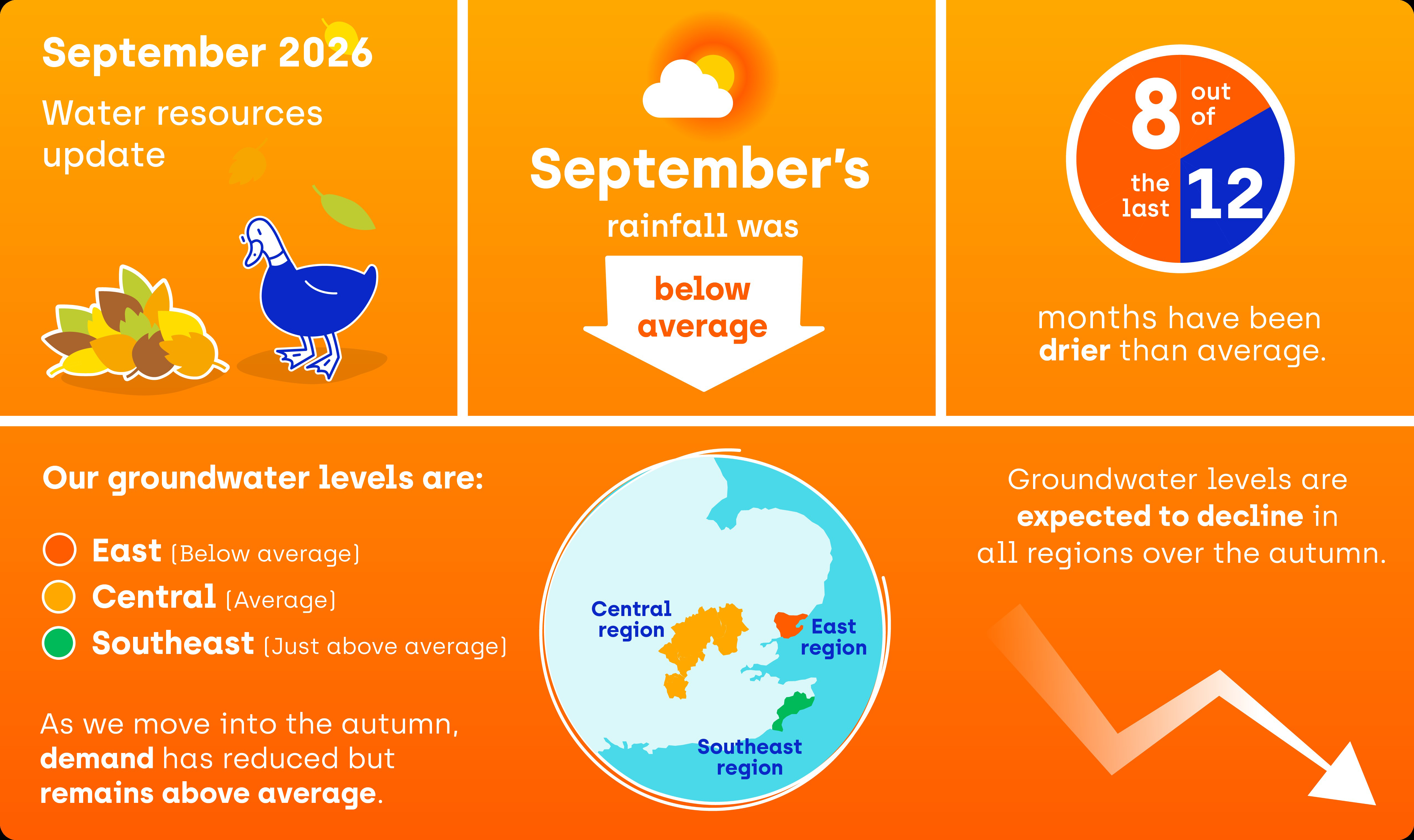
Groundwater levels are just above average in our South East region and below average in our East region. Both regions are 'in Environmental Stress', which is a term Affinity Water uses that means 'approaching drought conditions'. Groundwater levels in our Central region are average. However, we do expect levels in all regions to carry on falling and dip below average in the autumn, to a point where they are all in Environmental Stress.
Water levels are below average in Grafham Water reservoir, which usually provides about 10% of the water supply in our Central region. Also, in Ardleigh reservoir, which normally provides around a third of the East region’s supply. The demand we're seeing for water isn't as high as it was in the peak in the hottest summer months, but it's still above average, even as we move into autumn.
Central region - Our water resource position - Central
East region - Our water resource position - East
South East region - Our water resource position – South East
Anglian Water
August 2026
“A Temporary Use Ban (better known as a hosepipe ban) is now in place for household customers across the Anglian Water region.
While these restrictions do not apply to non-household customers, we're sharing this update so you're aware of the current position and can support conversations with your customers where appropriate. You can find more information about the Temporary Use Ban, including the restrictions that apply to household customers and why they've been introduced, on our dedicated webpage.
For more information: https://www.anglianwater.co.uk/help-and-advice/save-water/hosepipe-restrictions
Anglian Water are asking non-household customers in Norwich to go further to cut their water usage to keep taps flowing. With exceptionally low river flows in Norfolk, and as we prepare for the fifth heatwave so far this year, we’re letting retailers in Norwich know that they need to ask their customers to help protect water supplies by only using water for essential purposes with immediate effect. This is above and beyond the current Temporary Use Ban (also known as a hosepipe ban). Without everyone in the area reducing their consumption and only using water for essential purposes only, there’s a significant risk that supplies will go on to be affected.
What non-essential water use could you stop right now?
We appreciate that ‘essential’ will mean different things to different customers. But here are just a few examples of some activities customers could look to stop doing while water supplies are at risk:
- Watering outdoor plants
- Filling or maintaining pools and ponds
- Operating vehicle washing equipment
- Cleaning any kind of vehicle
- Cleaning industrial plant
- Cleaning windows
- Supressing dust
- Operating cisterns in any unoccupied buildings/offices.
Please note, these aren’t the only ways customers can look to reduce their water use and are just examples of common ways to cut back. We’d ask all non-household customers to look carefully at their own activities which involve any amount of water use. It’s important to know that we’re seriously considering the use of a Non-Essential Use Ban which would restrict customers from doing the activities listed above (and more), so anything you can do now will help us manage the water network more effectively. Every litre saved at work or home helps protect water supplies and the environment.
Why is this happening?
Despite a couple of wet winter months, the East of England has experienced its second driest spring on record this year. July was the UK’s sunniest and driest on record, with just 0.8mm of rainfall on average across the East of England (that’s just 1% of the long-term average rainfall we’d normally expect at this time of year). That led to the Environment Agency declaring a drought for the East of England at the end of July.
Why is this a particular challenge for Norfolk?
The flows in the River Wensum, which we rely on to keep taps flowing across Norwich and surrounding communities, are currently exceptionally low. In fact it’s one of the lowest ever since records began in 1960s. As a result, it’s under severe pressure following months of dry weather and taking much more from it will add to the ecological stress on the river.
Despite this, demand for water is still higher than our storage levels. During previous heatwaves this year, we’ve put as much as a third more water into supply than we typically need to, but this in turn puts additional pressure on the environment and our network of pipes, pumps and treatment plants.
Following the introduction of a temporary use ban (also known as a hosepipe ban) about a month ago, customer demand reduced by an initial 9 per cent, which has now stabilised at around 5 per cent. While we know that customers in the East of England are already some of the UK’s most water efficient, an additional challenge comes from the fact it’s also the driest region of the country.
What are we doing?
While our teams are treating and supplying more water than usual, fixing leaks around the clock and moving water around our network to meet demand, we still need customer support to help protect water supplies through the rest of the summer. Norwich already has the lowest leakage per kilometre of water main in the country, but we’ve also stepped up our resource to find and fix more leaks than ever. We’re using innovative techniques like drones and AI to locate leaks, and we’ve now got a bigger team than ever before to drive leakage rates down. This includes more boots on the ground with teams redeployed from other work to this priority – this is all on top of our already industry-leading day-to-day leakage work. This sits alongside longer-term work to make the East of England more resilient to drought. Operating in the driest region in the country, and the most vulnerable to the impacts of climate change, we’re well-versed in preparing for periods of prolonged dry weather. We already invest hundreds of millions every year to build our region’s resilience against the challenges posed by climate change – investments such as installing 1.5m smart meters; our mammoth 300km strategic interconnecting pipeline, which is already delivering huge benefits for drought resilience in Ipswich and Colchester; and replacing 1,000km of water mains to reduce leaks and bursts.’
Environmental Agency
Resources
View the latest summary reports on dry weather and droughts in England
View the latest Dry Weather information
September 2026
The government has today urged water companies not to lose momentum and carry on water efficiency measures until the drought is over. Public water supply was the focus of the latest National Drought Group meeting with water company chief executives called to give updates on their leakage reduction plus autumn and winter preparedness.
There were no changes in status, with almost three-quarters of England remaining in drought after an exceptionally dry spring and summer, alongside a succession of heatwaves. Drought is only over when rivers, groundwaters and reservoirs are back to normal levels – and the latter two continue to recede, as expected. New research has shown we need 120% of typical rainfall over the next seven months for all areas to be considered out of drought.
Northumbrian Water
July 2026
We have recently reported our Suffolk operating region entering Drought Level 1, and are encouraging all customers to follow user water wisely messages and strongly encourage voluntary restrictions in this region..
Essex and Suffolk Water are working very hard to manage resources carefully to avoid as little impact as possible to water supplies and are delivering high level water efficiency messages through our social channels through this period.
Scottish Water
June 2025
"Water levels in reservoirs have fallen to an average of 77% this week, 13% below the average for this time of year and 16% below levels this time last year. Scottish Water is continuously monitoring the levels of storage throughout the country to maintain supplies. Although demand for water has reduced by about 60 million litres per day after our request last week, it is still at elevated levels.
"There is some rain forecast for this coming weekend however, it will take a sustained period of rain to recover to normal levels. In the meantime Scottish Water is working to ensure it can maintain public water supply to customers in parts of the country affected by increased peak water use and is using tankers to supplement normal water supplies in some areas such as: Gullane, Aberlady in East Lothian; areas north of Aberdeen such as Potterton, Middleton Park, and Belhelvie; Maybole, Turnberry and Maidens in South Ayrshire; Kippen and Balfron in west Stirlingshire; and the Strathpeffer area in Ross-shire. We are also taking other action in some parts of the country, including supplementing borehole supplies from the River Spey by pumping water directly from the river to maintain normal supplies in Moray.
"Alex Plant, Scottish Water’s Chief Executive, said: “We’re working hard to maintain normal supplies for all customers and would ask that they use water efficiently to protect this precious resource. “Scotland’s climate is clearly changing and, as a country, we need to ensure we adapt both by investing appropriately in water infrastructure, which Scottish Water is doing, and ensuring we do what we can to use water more efficiently in our homes and businesses."
Severn Trent
July 2026
As we head into a prolonged period of warmer weather, we'd like to reassure our business customers that Severn Trent is well prepared for the summer ahead.
Thanks to long-term planning and significant investment in our network, we're entering the summer in a strong position. We've achieved our lowest-ever leakage levels and are investing more than £400 million to replace over 800 miles of water mains, alongside using innovative technology such as drones to identify and fix leaks faster.
Our teams continue to monitor and manage water supplies around the clock. Recent events have highlighted the resilience of our network, including during England's World Cup match against Mexico, when water demand increased by an additional 1.54 million litres overnight. Demand patterns shifted significantly as pubs, hospitality venues and other businesses showing the game experienced busy periods, alongside spikes in water use at half-time and after the final whistle. Despite these unusual overnight demand patterns, supplies were maintained across the region, helping businesses stay open and serve customers without interruption.
While current reservoir levels remain healthy and our region has not experienced summertime restrictions for more than 30 years, hotter, drier summers and less predictable rainfall mean it's increasingly important that we all value water as the precious resource it is. Using water efficiently can help businesses manage operating costs while supporting long-term resilience for communities, the environment and the regional economy.
How Businesses Can Help
For businesses and business owners who are also customers within our region, small actions can help reduce demand during periods of hot weather, lower costs and support long-term water resilience:
- Keep drinking water chilled in fridges rather than running taps to cool water.
- Avoid unnecessary watering of lawns and green spaces during dry weather - lawns are resilient and will recover naturally.
- Regularly inspect toilets, urinals and water-using equipment, as small leaks can significantly increase water use and costs over time.
- Review irrigation, cleaning and cooling processes to identify opportunities to reduce or reuse water where practical.
- Reuse water where operationally appropriate and encourage colleagues to be mindful of water use during warmer and peak periods.
- If you have a pool on-site or at home, keep it covered where possible to reduce evaporation and reuse water rather than refilling.
These small steps can make a meaningful difference when adopted across the thousands of businesses we serve.
Together, through continued investment and responsible water use, we can help ensure resilient water supplies that support businesses, communities and the environment throughout the summer and beyond.
South East Water
October 2026
From Friday 9 October 2026, the removal of certain exemptions under our Temporary Use Ban (TUB) is now legally enforced across our Sussex supply region. Following an exceptionally hot and dry year, water levels in our Sussex reservoirs, particularly Ardingly Reservoir, are extremely low. Removing these exemptions is a necessary statutory step to safeguard essential public water supplies and protect the local environment.
What this means for your business customers
Hosepipe restrictions have now been tightened across Sussex. The following commercial and service activities using mains water via a hosepipe are no longer exempt and are restricted from today:
- Cleaning services for customers: Hosepipe cleaning of windows, walls, paths, patios, and outdoor artificial surfaces carried out as a business service.
- Commercial vehicle cleaning: Hosepipe cleaning of private motor vehicles, trailers, or private leisure boats as a commercial service.
- Pool construction and renovation: Filling or maintaining domestic swimming pools or hot tubs following construction or repair using a hosepipe.
- General domestic pond maintenance: Standard filling or maintaining of domestic ponds using a hosepipe.
What remains permitted under statutory exemption
The following activities remain permitted:
- Health and safety: Essential hosepipe use required to prevent health or safety risks to humans or animals.
- Animal welfare: Hosepipe use where the health and welfare of animals or fish is paramount.
- Alternative water sources: Water drawn from water butts or recycled water storage systems.
- Commercial crops and agriculture: Watering plants grown for sale or commercial use, National Plant Collections, or temporary public flower displays.
- Efficient irrigation and sports pitches: Drip/trickle irrigation systems (fitted with pressure valves and timers), watering cans, and sports pitch active-area watering (outside 8:00 AM–10:00 AM and 5:00 PM–9:00 PM).
Please refer to the FAQs on our website and the Public Notice with the list of statutory exemptions.
Action we are taking
Alongside these restrictions, we’re taking active measures to protect drinking water supplies for customers:
- Granted a Drought Permit to reduce required environmental river releases from Ardingly Reservoir.
- Applied for a Non-Essential Use Ban. This is an application only. Even if granted, it will only be implemented if the drought situation in Sussex becomes more severe. The consultation period is now open until Friday 16 October. More information about how to comment or view our application can be found here.
- Reactivating a local water treatment works and fast-tracked a pipeline connection from Kent to supply extra water to East Sussex.
- Deploying additional leakage repair teams to fix leaks and bursts in Sussex.
- Managing network pressure to minimise pipe stress.
We are sorry for the disruption these restrictions may cause to your business customers. We are extremely grateful for your cooperation and efforts to conserve water during this critical period.
South Staffs Water
July 2025
“As you are aware we have had a period of very hot and dry weather, with rainfall in June at only 38% of long-term average, following on from the previous three months all below average. This continues to put pressures on our water resources as our customers have increased their demand by 30%.
We have increased our communications with customers on socials, local newspapers and radio encouraging them to use water wisely. The details of this can be seen on our website
Be water-wise during the hot weather | South Staffs Water
Be water-wise during the hot weather | Cambridge Water
Call for support
As before, we are still encouraging all water users in our region, including non-household users and NAVs, to also promote the need for water efficiency to their customers, through outlining the current weather situation and the impact on overall water resources. With a message to encourage businesses to be more conscious of their water use where possible.
We are aware that our non-household customers will use water in a variety of ways which is difficult to target messaging to. We strongly encourage the reduction of water use where it is possible. However, all businesses can be mindful of their domestic water use and we would encourage them to be water efficient in these areas in the same way we ask our domestic customers to be.
For more information on South Staffs current water resources, visit our website
Southern Water
July 2026 - Hampshire and the Isle of Wight drought update
Recent prolonged dry conditions have had a significant impact on the River Test, which supplies most of the water to homes and businesses across Hampshire and the Isle of Wight. River levels are now critically low, around 25% below normal for this time of year, and have fallen by a third in just one month. With little meaningful rainfall forecast, we must act now to protect this vital habitat and ensure a reliable supply of water for our communities.
However, we need help from our customers to reduce demand. For this reason, we are introducing a Temporary Use Ban (hosepipe ban) across Hampshire and the Isle of Wight from 00:01 on Friday 10th July 2026.
Whilst these measures will primarily affect household customers, some business customers will also be affected. Our published FAQs can be found here.
Please see a list of publications below that we will use to make our announcement:
South West Water
August 2026
From Saturday 8 August we will be introducing a Temporary Use Ban (TUB) for household customers in Devon, Cornwall, parts of Dorset and Somerset and the Isles of Scilly. Whilst Temporary Use Bans (TUBs) do not directly impact NHH customers, we would ask that they are mindful of their water usage during this challenging period.
Household information below:
To help protect water supplies, customers are asked not to use hosepipes for:
- Watering gardens and plants
- Washing cars
- Cleaning patios and driveways
- Washing boats
- Filling swimming pools, hot tubs and paddling pools
Why is a hosepipe ban necessary?
This decision follows one of the driest periods in recent years, with rainfall across the South West remaining well below seasonal averages over many months. Most recently, the Met Office has announced that England and Wales have provisionally recorded their driest July on record, with Southern England seeing its driest month ever recorded.
The Environment Agency has also recently declared half of England, including the South West, in official drought.
Prolonged warmer, drier weather has also led to increased demand for water placing pressure on resources, these temporary restrictions help to protect water suppliers for homes, businesses and critical services.
What have we been doing?
Our teams have been working hard to protect water supplies for customers. We've maximised water production wherever possible, increased leak detection and repairs, moved water around our network and introduced a wide range of operational measures to make the best use of the water available.
How long will the restrictions last?
We understand that hosepipe restrictions can be inconvenient, and this decision has not been taken lightly. We'll continue to monitor drought conditions and we will keep you updated.
We need everyone's help
We're asking everyone across the region to use water wisely to protect essential supplies. Taking shorter showers, turning the tap off when you brush your teeth and running washing machines and dishwashers with full loads can make a big difference.
For more information about the hosepipe ban, the exceptions that may apply and for water saving advice, please visit: www.southwestwater.co.uk/hosepipe-ban.
Thames Water
October 2026
Effective from 9 October 2026, Thames Water has moved to Drought Event Level 3 (DEL3) across the Swindon and Oxfordshire (SWOX) Water Resource Zone following an internal drought risk assessment.
Why have we moved to DEL3?
As part of Thames Water's ongoing drought management and resilience planning, we continuously monitor a range of environmental and operational indicators to assess drought risk across our supply area.
Following our latest assessment, these indicators have met the threshold for Drought Event Level 3 (DEL3) in accordance with our Drought Risk Assessment.
Useful links:
United Utilities
June 2025
"We are writing to provide an update on our water resources situation, as you’ll be aware, we have been experiencing a prolonged period of dry, warm weather across the region and it has been the driest Spring since the 1950’s. Water levels in the North West’s rivers, lakes, groundwaters and reservoirs are currently lower than average for this time of year. We’ve continued to see the risk of wildfires across our region and other sectors, like agriculture and growers, are struggling with the dry ground conditions.
"There are a number of actions we are taking to help safeguard water supplies and protect the environment. To help encourage reductions in water use, we will be sending some direct communications to business customers (please see copies attached) and increasing our messaging through normal media channels, urging people to act now.
"During the warm weather, our teams have been cleaning and putting more water into supply to match the demand for it. At times, the extra water being used is equivalent to supplying a town the size of Blackpool and the Fylde coast area. Our water resources team and hydrologists are monitoring the situation daily, to ensure we manage and balance this demand in the best possible way.
"Our well tested plans include using our vast integrated network of pipes to move water around from one part of the region to another, where it is needed. Customers in some areas may notice some slight changes in the taste of their water as we move water around. While this may be a bit different, customers should be reassured that their tap water will continue to meet all stringent water quality requirements.
"We have also begun reducing water pressures in some areas. This is being done in line with BAU pressure management levels, and we are taking great care to ensure that sensitive customers are not affected. If any of your customers experience supply issues, please direct them to contact us on 0345 075 0713.
"We will have brought around a further 75 million litres of water each day into the system by the end of the month from sources that have existing abstraction licences.
"We continue to find and fix leaks as quickly as possible, a task made even more challenging by the dry weather. As the ground dries out, it moves and this can cause some of our water pipes to shift and leak. Last week we fixed 900 leaks, more than we have ever repaired before in that timescale and we are at our lowest ever level of leakage. Since our last email explaining how dry it has been, we’ve seen a fantastic response and the number of leaks reported to us has significantly increased. We encourage everyone to report any leaks to us via our app, website or by calling 0345 672 3723.
"We have been sharing updates over the past few weeks and continue to urge everyone to act now and do all that they can to reduce the amount of water used, helping to manage the impact on their local environment and, in turn, if on a meter, saving money on both water and energy.
"Since April, we:
- have sent targeted information to more than 550,000 households and businesses in hotspot areas where demand was high;
- have sent over 2 million emails to customers across the region to ask for support in saving water where they can;
- contacted more than 160,000 households where we can see water usage has increased and could be due to a leak;
- switched daily messages on the regional ITV weather sponsorship to water saving information, reaching 4.2 million adults in the North West;
- are promoting water saving messages through On Demand TV, reaching 2 million people;
- are running daily information across commercial radio stations and have taken part in local BBC radio shows;
- have included messages in regional newspapers, with a combined readership of over 800,000;
- are using digital and all our social media channels to share our information and advice;
- have contacted youth groups across the Northwest; and
- are sharing our information with partner organisations across the region, including asking for the support of our supply chain in ensuring water is being used carefully across all operations.
"With some rain in the forecast, this may mean demand reduces and people may be tempted to think saving water won’t be needed. However, we need a few weeks of rainfall to help reservoirs recover to normal levels for this time of year so we are asking people to use less water where they can.
"We are working collaboratively with colleagues in Yorkshire Water to spread the messages about the impact of the dry weather, highlighted in particular by a spate of moorland fires on both sides of the Pennines.
"Thank you for helping us to save water."
Wessex Water
August 2026
“Wessex Water is announcing a Temporary Use Ban (TUB – or hosepipe ban) which will come into force just after midnight on Tuesday 18th August.
For more than 40 days, demand has remained at record breaking levels across our region. This, combined with the prolonged dry weather and a continued lack of rainfall forecast has been really exceptional – so exceptional that this is the first time in 50 years that we have had to take this step. Our challenge throughout this summer has been moving water through the network quickly enough to meet these record levels of demand. This also has an impact on our underground storage reservoirs, which normally replenish with treated water quickly. If we don’t take action now, we may not be able to protect our water resources.
We have appealed to customers and businesses for help, but we have unfortunately not seen the dramatic improvement that was needed. The perfect storm of drought, hot sunny weather and summer holidays has been so sustained that we need to take the difficult decision to introduce restrictions. This means that from tomorrow, Tuesday 18 August, our 1.4 million supply customers – in areas including Bath, and parts of Somerset, Dorset and Wiltshire–must not use a hosepipe for activities such as watering gardens, washing cars, patios, paths and driveways, cleaning windows or filling swimming and paddling pools."
More information can be found on the Wessex Water website:
Yorkshire Water
September 2025
"Last week Yorkshire Water moved into Drought Level 3 as a result of the low reservoir levels. There are no current plans to implement non-essential use bans (NEUBs). This week we have seen the first increase in our reservoir stocks in many months as levels increased from 0.2% to 30.8%, although a modest improvement we are hopeful that the recent rain will continue to see our position stabilise over the coming weeks.
Drought permits have been granted on the Rivers Wharfe and Ouse, as well across North West and South groups, this will allow to take more water from rivers and help slow the rate of and decline across our reservoirs. Further permits have also been applied for in South West group, more information on this can be found on our website: Yorkshire Water - Drought permits"